
Tyla Walker
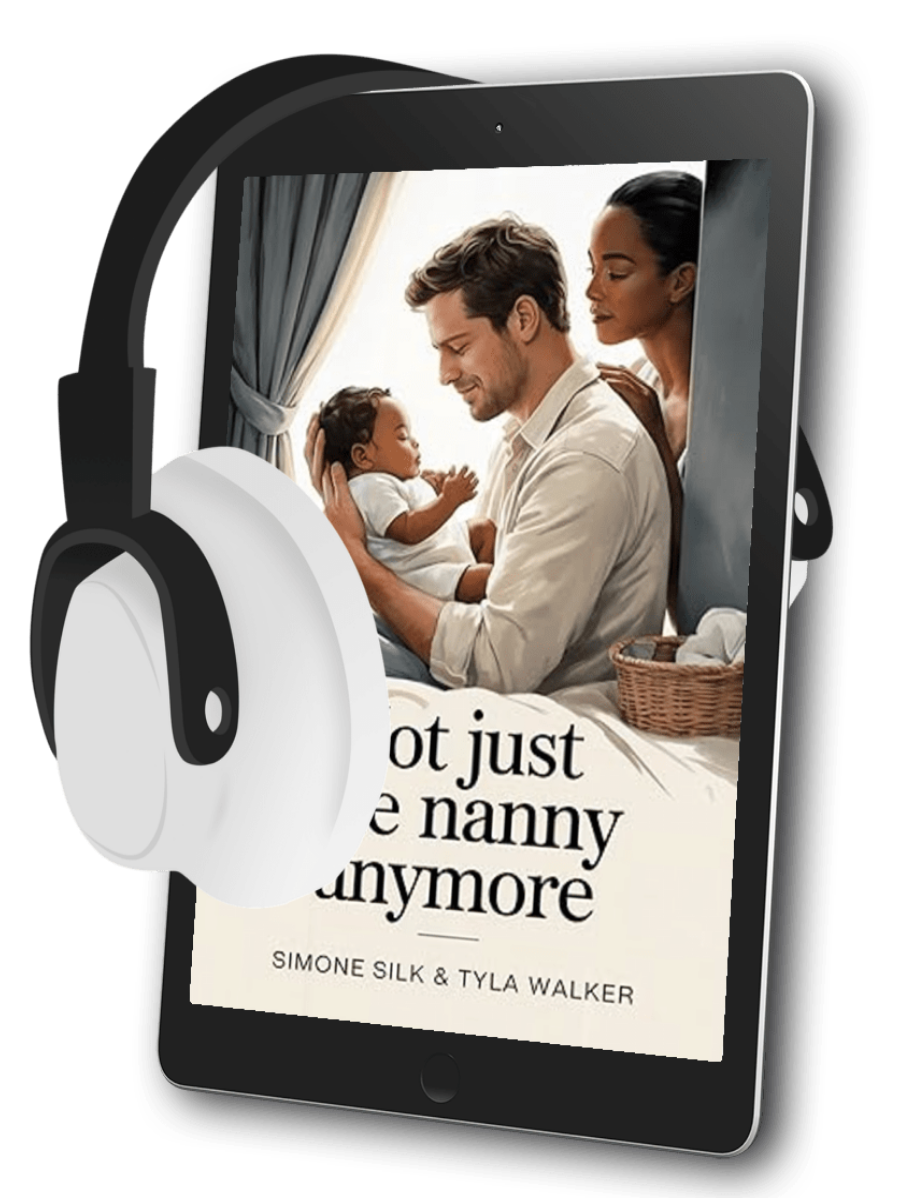
Not Just the Nanny Anymore | BWWM Widower Romance Audiobook (Dual)
Not Just the Nanny Anymore | BWWM Widower Romance Audiobook (Dual)
Couldn't load pickup availability
- Buy ebook
- Receive download link via email
- Send to preferred e-reader and enjoy!
Get the full, unabridged version with all the spice. Only available here
She was hired to help.
She forgot what happens when you save a man like me.
My wife is dead.
My daughter is barely six months old.
And the woman walking through my front door just brought the one thing I can’t afford: softness.
Naomi hums lullabies like prayers.
She folds my daughter into her arms like she was born to carry us both.
And she looks at me like I’m not drowning. Like I’m not broken.
But this house isn’t safe.
Not with secrets in the nursery.
Not with whispers in the walls.
Not with my late wife’s sister watching us like she’s still owed something.
Naomi doesn’t know it yet.
But she’s not just the nanny anymore.
She’s mine.
And if anyone touches her — God help them.
I buried one woman already. I won’t bury another.
Read on for protective widowers, dangerous sister-in-laws, obsession that blooms in grief, and a man who learns to breathe again—because she taught him how. HEA Guaranteed!
Chapter 1 Look Inside!
Chapter 1 Look Inside!
Chapter 1
Gabriel
The rain doesn’t fall so much as it lingers in the air, turning every breath into damp heaviness that clings to my suit jacket. I stand at the perimeter of the grave and wonder how long it’ll take before I can breathe without feeling like I’m drowning.
The preacher’s voice drones in the background, a low hum that doesn’t quite reach me. Words about eternal rest and peace with God. Words that are supposed to comfort, but slide off me like water off stone. My hands are clenched in front of me, knuckles white, nails digging crescent moons into my palms. I don’t even realize I’m doing it until my mother touches my elbow, light and brief, as if she’s reminding me I’m still human.
I don’t answer. I don’t have the energy.
Across the casket, Samantha—my late wife’s stepsister—dabs delicately at the corner of her eyes with a folded black handkerchief. She looks the part of the dutiful mourner, standing tall in her tailored black dress, her blonde hair twisted into a sleek bun that doesn’t move despite the misty weather. People murmur about how strong she’s been, how she’s stepped in to help with the baby, how admirable her loyalty is.
If they were close enough to see the glint in her blue eyes, they’d know loyalty isn’t the right word. It’s hunger. I can feel it from here, the way she looks at me when she thinks I’m not paying attention.
The baby shifts in my arms, squirming against the starch of my shirt. My daughter. Six months old. A tuft of pale-gold hair against my chest, blue eyes she doesn’t quite know how to use yet, and a soft coo that cuts sharper than any knife. She doesn’t know she’s supposed to cry today. She doesn’t know what she’s lost.
Lucky her.
“Would you like me to hold her for a bit?” Samantha’s voice cuts into the fog of my thoughts. She steps closer, hand half-extended. Her nails are perfectly manicured, pale pink, no smudges. Always perfect, always prepared.
I shift my hold on the baby, drawing her in tighter against me. “She’s fine where she is.”
Samantha’s smile doesn’t falter, but I see the flicker in her eyes. Annoyance, quickly buried under layers of practiced composure. “Of course. You’re doing wonderfully, Gabriel. It’s not easy.”
That’s the thing about Samantha. Everything she says sounds like it’s dipped in honey, but there’s always a sting hidden beneath.
My mother steps up beside me, dark umbrella in one hand, her other hand resting firmly on my shoulder. She’s shorter than me by almost a foot, her silver hair swept into a bun that no amount of rain can loosen. Her dark eyes are sharp, steady—the only anchor I’ve had since this whole nightmare began.
“You don’t need to stay much longer,” she murmurs, her voice low enough not to carry beyond me. “The baby’s tired. You’re tired.”
I glance at her. The lines around her mouth are deeper than I remember, carved not just by age but by worry. She’s been watching me like a hawk ever since the accident, waiting for me to crack.
“I can manage,” I say. My voice comes out rougher than I intend.
Her eyes soften, but she doesn’t push. She never pushes. “When you’re ready, then.”
The service ends in a slow shuffle of footsteps and closing umbrellas. People drift past, murmuring their condolences, squeezing my arm, patting my back. “So sorry for your loss, Gabe.” “She was taken too soon.” “Stay strong for the little one.”
As if strength is a choice I can make.
The baby squirms again, fussing now. I rock her gently, bouncing her against my chest. Her tiny hand grips around my neck—the one holding my wedding ring—and tugs with surprising strength. I let her, because the weight of her palm steadies me in a way nothing else can.
“Gabriel.” Samantha again. She’s close enough now that I can smell her perfume—something expensive, sharp, floral. She leans in, lowering her voice like we’re conspirators. “You know I’m here for you. Whatever you need. Whatever she needs.”
I turn my head slowly, meeting her gaze dead-on. For a second, her smile falters. “I’m aware,” I say. Nothing more.
My mother clears her throat pointedly, and Samantha steps back.
We retreat toward the car, my mother taking the umbrella so I can shield the baby instead. The cemetery mud sucks at my shoes, a steady pull I have to fight with every step. By the time we reach the black sedan waiting at the curb, my shoulders ache from tension.
Inside the car, the world muffles. The baby coos, grabbing for my tie. I loosen it with one hand, letting her clutch the end like a toy. She gurgles, drool pooling at her chin, eyes bright as though we didn’t just bury her mother in the ground.
“Let her hold onto it,” according to my mother from the other seat, watching. “She needs something solid. You both do.”
I huff out a laugh that doesn’t sound like me. “A tie doesn’t feel very solid.”
“Then be the solid thing,” she says simply. “For her. And let me be solid for you.”
Her words sink in, heavy but not unkind.
Samantha’s car pulls out behind ours as we leave the cemetery. She waves once when we turn onto the main road, smile pasted back in place. Always watching. Always there.
My mother leans forward, her voice steady. “I’ll be looking for someone. A helper. Someone I trust. You can’t do this alone, Gabriel. Not while you’re working, not while you’re grieving.”
I want to argue. My pride stirs, the part of me that refuses to admit weakness. But the baby hiccups, then lets out a tiny wail that scrapes me raw. I bounce her gently, patting her back.
“I’ll consider it,” I mutter.
“No.” My mother’s tone brooks no debate. “You’ll let me do it. For her sake, if not for yours.”
I glance at her, but she’s already turned her gaze to the rain-slicked window, jaw set. I know that look. It’s the same one I inherited.
The baby settles against my chest again, soft breath tickling through the fabric of my shirt. For a moment, it’s just the three of us in the quiet car: me, my daughter, and the mother who refuses to let me drown.
And somewhere behind us, Samantha.
The Phillips estate in Illinois doesn’t look like a house of mourning when we pull into the circular drive. Lights blaze in every window, cars jam the gravel, and the faint hum of conversation leaks out the front door before I even set foot inside.
Inside, the air is thick with perfume, cologne, and the clink of crystal glasses. My wife’s name floats from every corner—spoken like an anecdote, a sigh, a chance to fill silence. People smile too much, laugh too loud, as though volume will keep grief at bay.
I step through the threshold with my daughter in my arms, and the crowd parts. They look at me like a relic, like a man surviving on borrowed time.
“Gabriel, so sorry.”
“Stay strong, son.”
“She was a treasure.”
I nod, nod again, say thank you until the words are hollow shells. My daughter squirms, sensing the noise. I bounce her gently, whispering into her downy hair.
My mother peels off to play hostess, her sharp voice corralling mourners toward the dining room. Samantha materializes at my side, hands clasped, expression soft. “You should let me hold her,” she murmurs. “Just for a moment. You look exhausted.”
“I’m fine.” My answer is clipped.
Her smile doesn’t falter. “Of course you are. But you don’t have to be. You’ve been through so much.” She lays a hand lightly on my sleeve, the gesture lingering half a second too long.
Before I can reply, my mother reappears with a tray of glasses. “Samantha, would you mind helping me in the kitchen?” Her tone isn’t really a question.
For the first time that day, I almost smile.
Upstairs, I settle the baby on the changing table and wrestle with the snaps of her dress. She kicks, giggling, as though mocking me. “You think this is funny?” I mutter. She squeals in response.
“You’re holding her like she’s a sack of flour.” My mother’s voice comes from the doorway, dry as ever. She steps in, plucking up the discarded blanket from the floor. “Try not to twist her arm out of its socket.”
“I’m doing fine,” I say, though my fumbling hands suggest otherwise.
She arches a brow. “Fine is not the word I’d use. Serviceable, maybe.”
I snort, shaking my head. “Thanks for the encouragement.”
She softens, reaching out to fix the strap I missed. “Encouragement isn’t what you need, Gabriel. You need rest. And help.”
The baby gurgles, clutching at my tie. My mother pries her fist gently open. “I’ll make some calls tomorrow. There’s someone I think will be a good fit.”
I want to argue, but exhaustion presses down like wet wool. “We’ll see.”
“You’ll see,” she echoes, but the firmness in her tone says she’s already made the decision for me.
By the time the last mourner drifts out, the house is mercifully quieter. I carry the baby downstairs, only to find Samantha still in the kitchen, setting a teacup on the counter.
“I thought everyone had gone,” I say.
“They have,” she answers smoothly. “I stayed to make sure you had something warm before bed. Chamomile. It helps.”
I glance at the cup. The steam curls upward, fragrant. Her eyes are fixed on me, too intent.
“I appreciate it,” I say, voice flat. “But you didn’t have to.”
“I wanted to,” she insists, stepping closer. “You shouldn’t be alone tonight. You’ve lost so much.”
My daughter fusses, tugging at my collar. I bounce her lightly, avoiding Samantha’s gaze. “I have company,” I say simply.
For a heartbeat, silence stretches taut. Then Samantha smiles again, brittle at the edges. “Of course. I’ll check in tomorrow.”
She leaves through the side door, perfume trailing like smoke.
In the nursery, I settle the baby into her crib. She clutches the stuffed rabbit her grandmother brought, rolling onto her side with a soft sigh. The room is too quiet, the kind that amplifies every thought.
I sit in the rocker, elbows on knees, the wedding ring heavy against my chest. My wife’s face flickers in memory—smiles that never quite reached her eyes, conversations full of pauses, the last argument before the trip.
The baby stirs. I hush her gently, the sound cracked and low.
“I’ll figure it out,” I whisper. “I’ll figure us out.”
But even as I say it, I hear my mother’s voice in my head: You need help.
Share